TL;DR
H2 is where the cost of delay shows up. CMMC Phase 2 hits in November. SEC Reg S-P is already enforceable. DSO expansion windows close in Q3. Early 2027 PE exit timelines start their countdown now. This guide tells dental, manufacturing, financial services, and PE leaders exactly what to pressure-test before December 31, and what to stop delaying.
Key Takeaways
- CMMC Phase 2 third-party assessments begin enforcement in November 2026 for DoD (United States Department of Defense, also referred to as the Department of War) contractors.
- SEC Reg S-P enhanced cybersecurity requirements are now in effect. Your documentation is the exam.
- Mid-year is typically when budget reallocation is decided; technology projects that are ready get funded first.
- vCIO adoption is accelerating in the mid-market of key industries, offering strategic leadership without the full-time hire, and the compensation package that goes along with it.
- IT findings that surface during PE due diligence reduce valuations or kill closings.
Why H2 Planning is Different
Annual planning runs on projections, but H2 planning runs on the actual data.
You know what slipped in Q1. You know which vendor relationships cost more than they should. You know whether your IT environment is keeping up with the business, or quietly becoming a liability.
H2 is also where budget conversations change character. Q4 is when organizations either spend down remaining budget or build the case for next year. Neither works without a clear picture of your technology posture right now.
Three things make H2 planning distinct:
- Mid-year correction. You’re adjusting course, not setting it.
- Budget reallocation. Unused Q1 and Q2 dollars get redirected in Q3, and ready projects move first.
- Q4 cluster. Vendor renewals, compliance deadlines, and audit prep all land at year-end. Work backward now.
Leaders who treat H2 planning as a real discipline outperform the ones who treat it as a check-in. It shows up in audit results, incident rates, and exit multiples.
Cross-Vertical Technology Priorities for H2 2026
Dental: Scaling Without Breaking
Dental groups are in an interesting moment. The DSO model keeps expanding, and single-location practices are either being acquired or forced to compete at DSO speed. Either way, the technology that worked for one location will betray you at two.
H2 priorities for dental:
- Multi-location network standardization is essential if you’re adding sites. Your infrastructure must scale, not get rebuilt at every door.
- AI in practice management is moving from nice-to-have to table stakes. Scheduling, billing automation, and treatment planning tools need to be evaluated before Q4 budget closes.
- HIPAA enforcement keeps sharpening and mid-year is the right time to pressure-test your incident response plan and verify your Business Associate Agreements are current.
- Backup and disaster recovery cannot be assumed. It must be tested. A backup that has not been restored is a hope, not a backup.
Private Equity: Exit Prep Does Not Wait for Year-End
For PE firms with portfolio companies targeting Q1 2027 exits, H2 2026 is the last real window to fix what is broken before the diligence process starts.
Buyers are looking harder at technology than they were five years ago. Disorganized IT environments, undocumented networks, and unresolved security findings do more than slow deals. They reduce valuations and kill transactions.
H2 priorities for private equity:
- Exit prep timing matters now. Q1 2027 transactions need remediation work starting in Q3 2026 at the latest.
- Portfolio standardization reduces risk. Inconsistent IT across the portfolio creates diligence complexity and integration cost.
- Due diligence readiness cannot be reactive. Documentation, asset inventories, security controls, vendor contracts — have these ready before the buyer asks.
- Operating partner alignment is the missing piece. Technology decisions at the portfolio level need a strategic sponsor. A vCIO engagement fills that role without a full-time hire.
Manufacturing: CMMC Phase 2 Is Not Optional
November 2026. That’s the date manufacturers with DoD contracts must keep top of mind.
CMMC Phase 2 assessments are moving from self-attestation toward third-party verification for many contract holders. If your organization has not started its formal assessment process, H2 is a deadline window, not a planning window.
H2 priorities for manufacturing:
- A CMMC Phase 2 gap assessment is the starting point. Understand where you stand against the 110 NIST SP 800-171 controls before a third-party assessor does.
- OT/IT convergence is creating new exposure on the plant floor. Operational and information technology are colliding, and the security implications are significant and usually unaddressed.
- Incident response is now a contract requirement. DoD contracts increasingly require demonstrated IR capability. Build it now, document it, test it.
- Supply chain risk can undermine your entire CMMC posture. Your compliance is only as strong as your vendors. Audit third-party access and controls in Q3.
Missing the CMMC window costs revenue. The contracts require compliance, and contracts pay the bills.
Financial Services: Regulation Is Now Enforcement
SEC Reg S-P enhanced cybersecurity requirements are in effect. For registered investment advisers, broker-dealers, and other covered entities, this is a current obligation, not a future concern.
H2 priorities for financial services:
- Reg S-P compliance review is not optional. Incident response plans, vendor oversight documentation, and customer notification procedures need to meet the updated standard.
- BEC prevention requires active testing, not assumptions. Business Email Compromise remains the top financial fraud vector. MFA, SPF/DKIM/DMARC, and wire verification protocols should be pressure-tested regularly.
- vCIO adoption is how leading firms stay ahead of regulatory complexity. Strategic IT leadership does not require the cost of a full-time CISO or CTO.
- Vendor contract review should happen before auto-renewing. H2 is when many service agreements renew. Confirm vendors meet regulatory requirements first.
Regulators look at documentation, not intent. Firms that can demonstrate controls on paper, in logs, and in policy are the ones that pass and avoid the headache of an audit or the financial impact of non-compliance.
The vCIO Opportunity: Strategic IT Leadership Without the Headcount
A pattern is showing up across regulated and growing industries: the organizations navigating technology complexity best are the ones with someone in a strategic IT leadership role.
That person is rarely full-time, and increasingly, it seems that’s by design. In these cases, it’s typically a virtual CIO: a fractional strategic technology leader who owns the roadmap, manages vendor relationships, and aligns technology decisions with business outcomes.
H2 is the right window to add this capability for three reasons:
- Budget season is coming. A vCIO builds the case for Q4 and next year before the window closes.
- Compliance deadlines are clustering. Whatever the mix looks like for your business (CMMC, Reg S-P, HIPAA, or some combination) having one strategic owner is the difference between proactive and reactive.
- Strategic decisions cannot wait. Multi-location expansion, M&A, and modernization require leadership and flexibility, not just implementation.
For mid-market organizations in these verticals, a vCIO is the most cost-effective way to get the strategic technology leadership the business needs.
Don’t Let Q4 Plan Itself
Vendor renewals, compliance deadlines, and audit prep all pile up at year-end. The leaders who get ahead of it treat H2 as a real planning discipline, not a scramble.
This guide gives you a mid-year framework to reset priorities before the crunch hits:
- A clear-eyed checklist for the deadlines clustering in Q3 and Q4
- Cross-vertical technology priorities, including what’s actually changing for dental, PE, financial services, and manufacturing
- A way to work backward from year-end so nothing lands on your desk by surprise
How to Run a Mid-Year Technology Assessment
A mid-year assessment is not a months-long project. Done right, it’s a structured conversation about current state, gaps, and priorities. It produces a clear action plan.
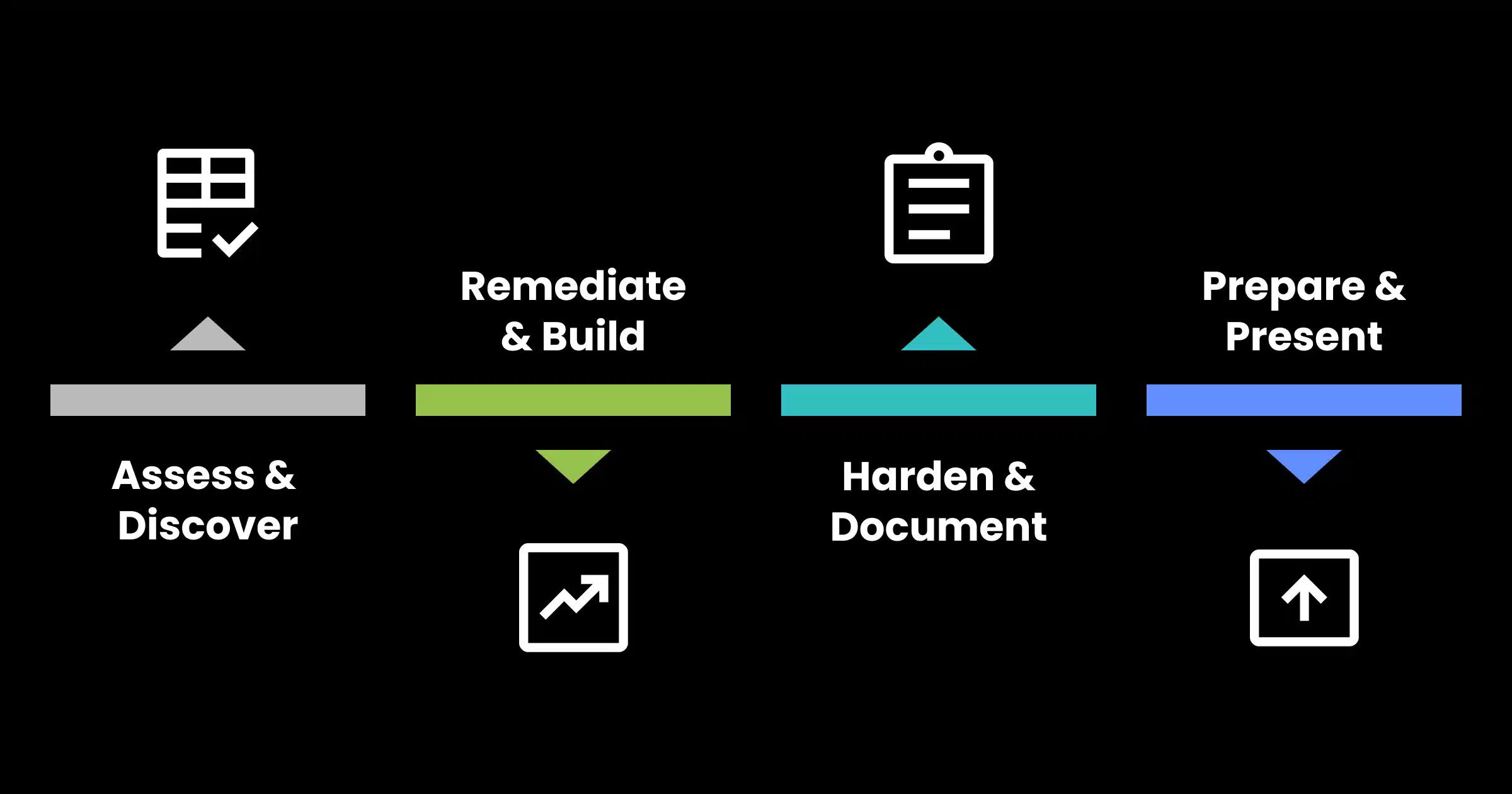
Step 1: Inventory What You Have
Hardware, software, cloud services, security tools, vendor contracts. Most organizations discover they are paying for things they do not use, or not protecting things they did not know they had.
Step 2: Pressure-Test Your Security Controls
Run a tabletop exercise. Test backup restoration. Review access controls. The goal is finding the things that matter most before something else finds them for you.
Step 3: Align Technology to Business Goals
What is the business trying to accomplish in H2? New locations? A transaction? A regulatory milestone? Technology planning disconnected from business objectives produces the wrong priorities. Connect them.
Step 4: Build a Prioritized Action List
Not everything needs to happen in Q3. Triage: what is a compliance deadline, what is a business risk, what is a long-term capability. Sequence accordingly.
This seems straightforward, because it is. The complexity lies in the details and proper prioritization. This is where a technology partner earns their service renewal or a new partner earns your trust.
Your H2 IT Roadmap: 3 Questions Every Business Leader Should Answer
Question 1: Are you prepared for your most likely H2 technology risk?
Not the most dramatic risk, but the most likely one. For dental, ransomware against the practice management system. For PE holding companies, IT findings surfacing during diligence at the wrong moment. For manufacturing, a CMMC gap that reveals more than expected. Or, for financial services, a BEC attempt that gets through because controls were not tested.
Question 2: Does your IT vendor relationship reflect where the business is going, or where it has been?
Mid-year is when vendor relationships deserve scrutiny. Is your IT partner growing with you? Are they helping you grow or holding you back? Do they understand your vertical? Are they proactive or reactive? The answers tell you whether to stay, upgrade, or change.
Question 3: Do you have a strategic IT voice at the leadership table?
Technology decisions are business decisions. If no one is translating between IT complexity and business outcomes at the leadership level (no vCIO, no strategic partner, no internal champion), that gap is costing you.
The Cost of Waiting
Reactive IT is expensive. Not just in direct costs like breach remediation, compliance penalties, and emergency vendor rates, but in opportunity cost. The organizations that wait for something to break are consistently behind.
- Healthcare data breaches cost an average of $7.42 million in 2025 — the highest of any industry for the 14th consecutive year (IBM Cost of a Data Breach Report 2025). Dental practices are not immune.
- BEC attacks cost U.S. businesses $2.77 billion in 2024 (FBI IC3 2024 Annual Report). Most successful attacks exploit gaps in email security controls that could have been closed for a fraction of the loss.
- CMMC non-compliance can result in contract suspension or termination. The revenue at risk far exceeds the cost of preparation.
- IT findings that surface during PE due diligence reduce valuations and delay closings, often by amounts that dwarf the remediation cost.
Proactive technology planning is risk management with a measurable ROI.
Frequently Asked Questions
How is H2 technology planning different from an annual IT review?
Annual reviews run on projections. H2 planning runs on actuals. Six months of data on what worked, what did not, and where the business is actually headed. That makes H2 planning more precise and closer to the compliance deadlines and budget windows that matter.
We are a single-location dental practice. Is this relevant?
Yes. Scale does not change the fundamentals. HIPAA compliance, backup verification, and vendor reviews apply at one location or ten. Complexity changes. Necessity does not.
What is the first step if we do not have a formal IT plan?
Start with an assessment. Understand what you have, what is protecting it, and where the gaps are. Everything else builds from that baseline. Arakÿta’s technology assessment produces a clear picture and a prioritized action plan.
Our PE firm manages multiple portfolio companies. Where do we start?
Start with the company closest to a transaction or with the most regulatory exposure. Portfolio standardization is the right long-term play, but triage by risk and timeline first.
We have been told we need a vCIO. What does that actually mean?
A vCIO is a fractional strategic IT leader who owns your technology roadmap, manages vendor relationships, and aligns IT decisions with business objectives. A strategist, not an implementer. Typically structured as a monthly advisory engagement. For most mid-market organizations, it’s the most cost-effective path to the leadership the business needs.
Ready to Build Your H2 Roadmap?
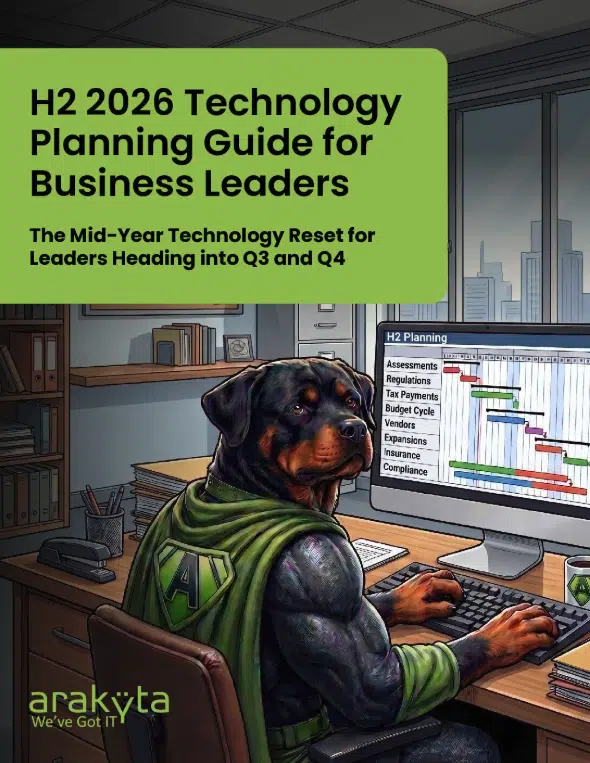
The H2 2026 Technology Planning Guide for Business Leaders walks through the compliance deadlines, financial windows, and strategic decisions that shape H2. Examples draw from our work in dental, private equity, manufacturing, and financial services, but the framework applies regardless of vertical.
Schedule a Mid-Year Technology Assessment with Arakÿta →
We’ve Got IT.